![Centro de Estudos em Geopolítica e Relações Internacionais [CENEGRI]](https://cenegri.org.br/wp-content/uploads/2023/11/cropped-CENEGRI-small2-1.png)
Cuba and the ‘Yankee threat,’ 30 years later: how Trump and the global economic crisis are pressuring the island by Charles Pennaforte
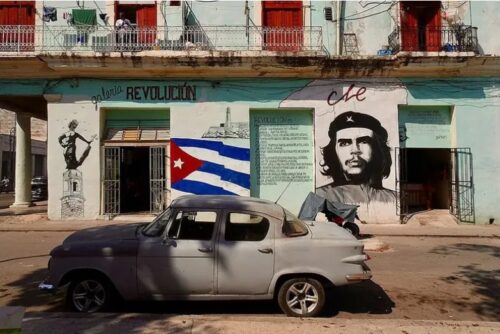
From the 1990s crisis to Donald Trump’s recent threats to “take” Cuba, silent reforms and external pressure have pointed toward a future of state capitalism or direct tutelage by the US.
In November 1994, I arrived in Havana for the first time. In August of that year, the so-called “Balseros Crisis” occurred, when tens of thousands of Cubans, pressured by harsh living conditions, took to the sea, heading for Miami. It is important to remember that the economic sanctions—or the economic blockade, as Cubans insist on calling it—were responsible for the dire economic situation at the time.
Constant blackouts, poor transportation, lines for basic food items provided through the libreta (libreta de abastecimiento) that ensured the minimum rationing necessary for the entire population, and an impressive daily inventiveness made up the scenario of the so-called “Special Period in times of peace.” Studies on the Cuban economy estimate that between 1989 and the mid-1990s, the country lost approximately 35% of its GDP, a contraction comparable to that of wars or major depressions.
In July 1995, I returned to the island for my second academic event and found the same country, but with subtle signs of adaptation: small family-run restaurants, informal markets, U.S. dollars circulating alongside a convertible currency—phenomena recorded in the literature as effects of the legalization of foreign currency in 1993 and the initial opening to tourism and joint ventures.
Three decades after the collapse of the Soviet Union, Cuba faces another historic crossroads, echoing, on a different scale, the pressure that marked the Bay of Pigs invasion—now under the shadow of a U.S. president who has openly spoken of “taking” the island. Since his return to the White House, Donald Trump has combined “maximum pressure”—reinforced embargo, new sanctions, restrictions on travel and remittances—with statements about a “friendly takeover” and regime change as merely a “matter of time.” In January 2026, he declared a “national emergency” regarding Cuba and signed an executive order that allows for additional tariffs against countries supplying oil to the island, further tightening the energy and financial stranglehold .
Between the Special Period and the current Trump offensive, there was a brief window of détente during the Obama administration, with the reestablishment of diplomatic relations, the reopening of embassies (2015), and a historic presidential visit to Havana (2016), in addition to broad relaxations on travel and remittances. However, even during this period, the embargo remained legally in effect, and Washington made it clear that it viewed the expansion of the Cuban private sector as a tool for the island’s gradual transformation.
Cuba has long ceased to be the classic socialist showcase of the Cold War. Currently, the possibility of the country becoming a “Caribbean shark,” in analogy to the Asian Tigers or Dragons of the 1980s and 1990s, is developing. A predominantly capitalist economy with a strong presence of foreign capital under the tutelage of the state and a single party. In other words, a tropicalized version of China or Vietnam, potentially conditioned by a U.S. project of supervised reintegration.
From the Special Period to the controlled market
In this context, the first significant market reforms emerged. In 1993, Havana legalized the possession and use of the dollar, expanded its openness to international tourism, and allowed the creation of joint ventures with foreign capital, especially in the hotel industry. This produced an economy segmented into three circuits: state, dollarized and informal. What I observed on the streets of Havana—small improvised businesses such as the famous paladares restaurants, survival networks based on remittances, and parallel markets—was a social laboratory for this transition.
With Raúl Castro, this process was reorganized under the label of “updating the economic model.” Between 2010 and 2011, the government announced the dismissal of approximately 500,000 state workers and expanded the list of activities permitted for self-employment, reaching approximately 178 occupations for cuentapropistas (self-employed workers).
In parallel, it created legal conditions for small- and medium-sized private companies, granted land usufruct to farmers, and approved a new framework for foreign investment, with the Mariel Special Development Zone as a showcase. The emerging private sector began to account for a considerable share of new jobs, while the state sector was “downsized.”
A crisis different from that of the 1990s
When discussing the risk of a new Special Period, it is tempting to draw a direct parallel with the 1990s. There are, in fact, similarities: supply shortages, energy problems, a decline in purchasing power, disillusionment with the future, and a new wave of emigration to the West. However, the current crisis is qualitatively different from the previous ones.
First, a private sector that did not exist on that scale previously has emerged. Recent analyses estimate that, when adding self-employed workers, employees of MSMEs (micro, small, and medium private or mixed enterprises created under the new economic legislation, especially after 2021), and private farmers, about 1.6 million people were employed in the non-state sector in 2025, roughly half of the workforce.
In 2024–2025, the private sector will surpass the state in retail sales, accounting for over 50% of consumer trade. The crisis affects a much more dualized economy, with a dynamic private segment coexisting with a shrinking public sector.
Second, Cuban society is more interconnected. Reforms in telecommunications and the gradual expansion of access to the Internet and mobile networks have opened channels for the circulation of information that did not exist in the 1990s, making protests and mobilization more visible and difficult to contain.
Third, the external environment has changed significantly. The alliance with Venezuela, which for years supplied oil under favorable conditions and acted as a “late USSR” for Cuba, declined with the Venezuelan crisis and sanctions. Simultaneously, China, Russia, and European actors are building a presence in sectors such as infrastructure, tourism, and biotechnology, viewing the island as a hybrid economy in transition.
This was exemplified by the American leadership’s open display of imperial behavior in the face of fragmented domestic opposition and a largely ineffective international response.
Finally, U.S. pressure took on a new form. In January 2026, the White House declared a national emergency regarding Cuba and established a framework of tariffs and sanctions against countries supplying the island with oil, thereby expanding the extraterritorial reach of the embargo.
In speeches and interviews, Trump stated that it would be “an honor to take Cuba” and that regime change was only “a matter of time,” reviving interventionist logic in the Caribbean under the rhetoric of “liberation” and business opportunities.
China in the Caribbean: Tutoring Venezuela or something new?
A plausible hypothesis is the consolidation of a “market socialism” model, à la China or Vietnam: a single ruling party, strong political control, gradual and selective opening to foreign capital, encouragement of a national business class aligned with the state, and prioritization of strategic sectors such as tourism, biotechnology, logistics, energy, and healthcare services.
Official documents regarding the “update” and external analyses converge on the idea that Havana aims to combine political discipline with economic pragmatism, attracting several billion dollars annually in direct investment.
In this scenario, the metaphor of the “Caribbean shark” helps frame the island as a heavyweight regional actor. Its geographic position between North America, the Caribbean, and Latin America, qualified human capital—especially in health and education—and experience in medical services and biotechnology are highlighted as advantages. The “shark” would be a type of tropical Asian tiger: small in demographic scale but aggressive in specific niches of the global economy.
However, there are significant obstacles. Cuba lacks the demographic scale and internal market of China; it faces low productivity, chronic shortages of external financing, and vulnerability to shocks, especially in terms of energy and food. In terms of the world-system, this is a peripheral economy attempting a “leap” within a structure still organized around the interests of central powers, particularly the United States.
This gives rise to a second scenario, already outlined by the Trump administration in the Venezuelan case: “supervised” reintegration (see above). In Venezuela, Washington combined military and judicial pressure, selectively eased sanctions, and reopened the country to major energy companies, reorganizing the oil sector under strong U.S. oversight.
Regarding Cuba, the script follows a similar pattern: national emergency, threats to punish countries supplying oil, tightening of the embargo, and the message that Havana could “avoid the worst” by returning property, opening up more broadly to U.S. capital, and, ultimately, changing the regime.
Imagining Cuba as a “Caribbean shark” therefore means admitting that this animal swims in waters mapped out by Washington. The same government that today strangles the economy with energy and financial sanctions could, tomorrow, present itself as the architect of a “recovery” based on privatization, the return of assets to American companies, and the conversion of the island into a business platform under its protection.
In contrast, we must not forget that the Cuban political-ideological structure bears no resemblance to that of Venezuela in terms of its cohesion. The actions of the Communist Party of Cuba did not occur in a “top-down” manner as they did in many Eastern European regimes.
It is not an artificial ideology: up to the present moment, even with pressure from the US since the 1960s, the regime has remained cohesive and centralized, with strong social roots, intense nationalism, a permanent “siege mentality,” and the explanation of internal problems as a result of the economic blockade. However, the situation is no longer as favorable.
A shark surrounded by nets
The trajectory of the past three decades suggests that Cuba may be moving toward a form of post-communism in which the economy tends to become predominantly capitalist, with multiple private actors and a strong presence of foreign investment; the state and the party seek to preserve political control; and external dependence is being reconfigured, shifting from what was once a Soviet axis to a constellation of North American, European, and Asian capitals.
Recent statistics indicate a decrease in the number of public employees (from approximately 3.1 million in 2019 to 2.7 million in 2023) and the rapid growth of the private sector, which already dominates more than half of retail sales.
The difference compared with the 1990s, which I witnessed in Havana, is that now the internal transition is taking place under the explicit pressure of a U.S. government that does not hide its ambitions for expansion and regime change. When Trump says it would be “an honor to take Cuba” and that the island’s government is “ready to fall,” he signals both a threat and an opportunity. The further the economy is pushed to the limit, the more plausible it becomes that a solution will emerge in which the “Caribbean shark” appears as the result of a negotiated arrangement with Washington, and not just as a product of the reforms initiated during the Special Period.
If it was challenging to imagine a future of managed capitalism in Havana in 1994 and 1995, that future is suggested in every economic reform, every negotiation with investors, and every protest against shortages today. Cuba is no longer what it once was, but it is not yet what it might become in the future. The question that remains is whether it will be able to turn vulnerability into momentum and truly emerge as a Caribbean shark, and at what social and political cost this will occur.
References
Originally published in Portuguese in https://theconversation.com/cuba-e-a-ameaca-ianque-30-anos-depois-como-trump-e-a-crise-economica-mundial-estao-pressionando-a-ilha-278861